

Your gymnastics club is thriving. Classes are filling up, new families are joining, and excitement is in the air (from staff and students). But let’s be honest, behind the scenes, things might feel a little chaotic. Overfull classes are creating safety concerns. Cash flow is unpredictable because invoices get lost or payments arrive late. Parent messages scattered across WhatsApp, email, and scraps of paper stuffed in your gym bag.
Sound familiar? You’re definitely not alone. Many gymnastics clubs hit this exact wall once they pass 80–100 members, and the hard work that got you here suddenly isn’t enough to keep things running smoothly.
Here’s the good news: organizing a growing gymnastics club requires a shift from manual, “hands-on” management to streamlined, automated systems. The best way to organize a growing club is to structure people, programs, and processes around a single, central system, such as Class Manager's gymnastics management software, rather than relying on ad hoc spreadsheets and messaging apps.
Class Manager is cloud-based management software built specifically to help organisations across the UK, US, and Australia streamline scheduling, billing, and communication as they grow. This article gives you a practical, step-by-step structure that a club with 150–600 gymnasts can implement to help with growing administrative tasks as you expand.
Let's get into it. We'll cover everything from switching to an all-in-one software to managing your schedules, cash flow, and membership pricing structures.
Build a Clear Administrative Structure from Day One
Most gymnastics clubs start as a one-person business, a passionate coach handling everything from teaching to billing to answering late-night parent texts. That’s fine at the beginning, but growth beyond 80–100 gymnasts demands defined roles and systems. Without them, you’ll burn out, or quality will slip.
Automating administrative tasks is critical for efficiency as membership grows. And yes, that means moving away from paperwork and WhatsApp....
Define concrete roles early: Your instructors leading sessions, receptionist/admin role to handle bookings and day-to-day enquiries. Financial officer, who keeps an eye on the billing, invoicing, and other tasks.
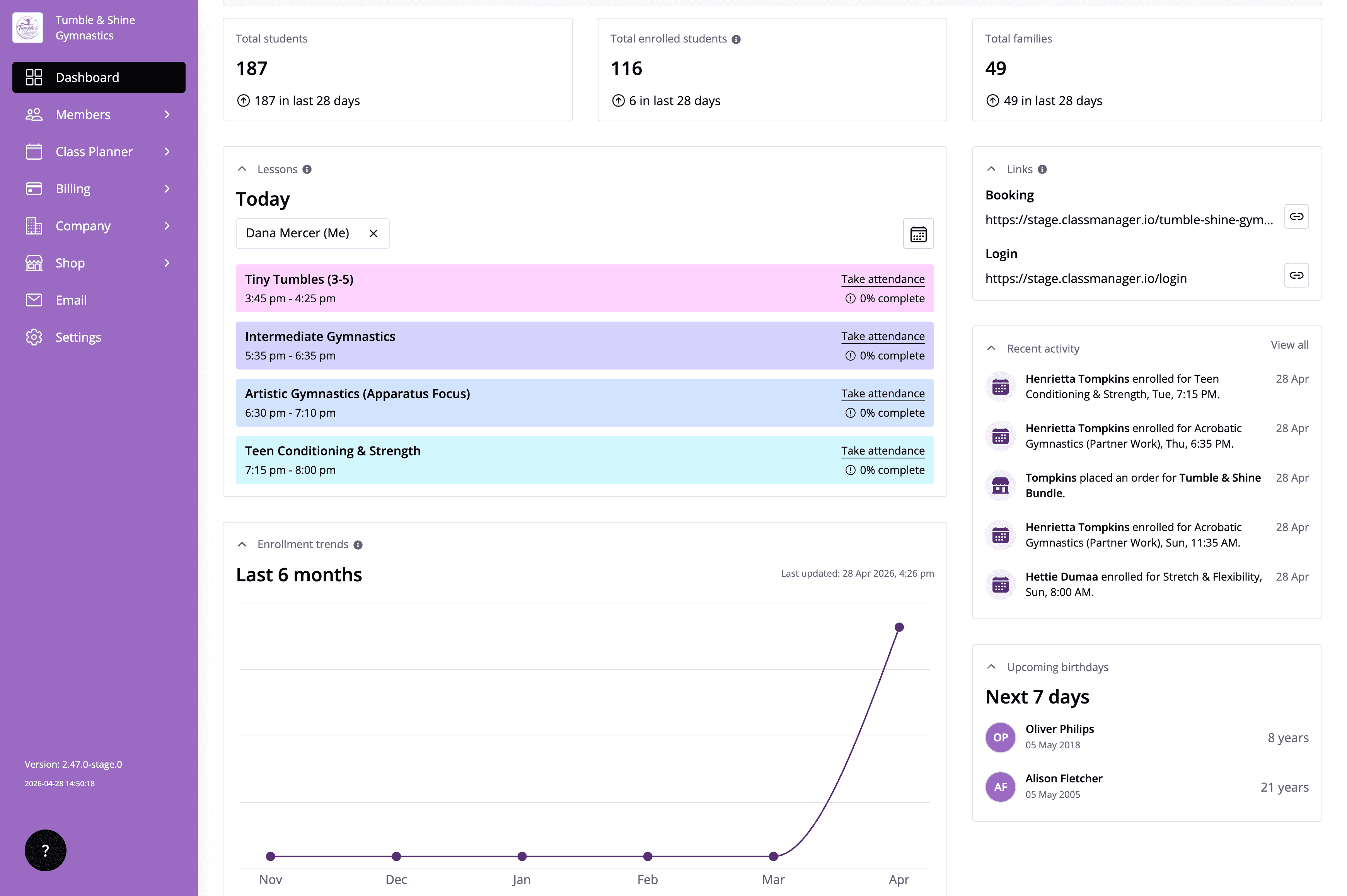
Centralize admin in Class Manager: Replace paper forms, manual bank transfers, cash, and scattered spreadsheets with a single platform. This becomes your source of truth for member records, medical info, digital waivers, and policies.
Use staff permissions wisely: Coaches can view attendance registers and athlete notes while sensitive finance data stays restricted to those who need it.
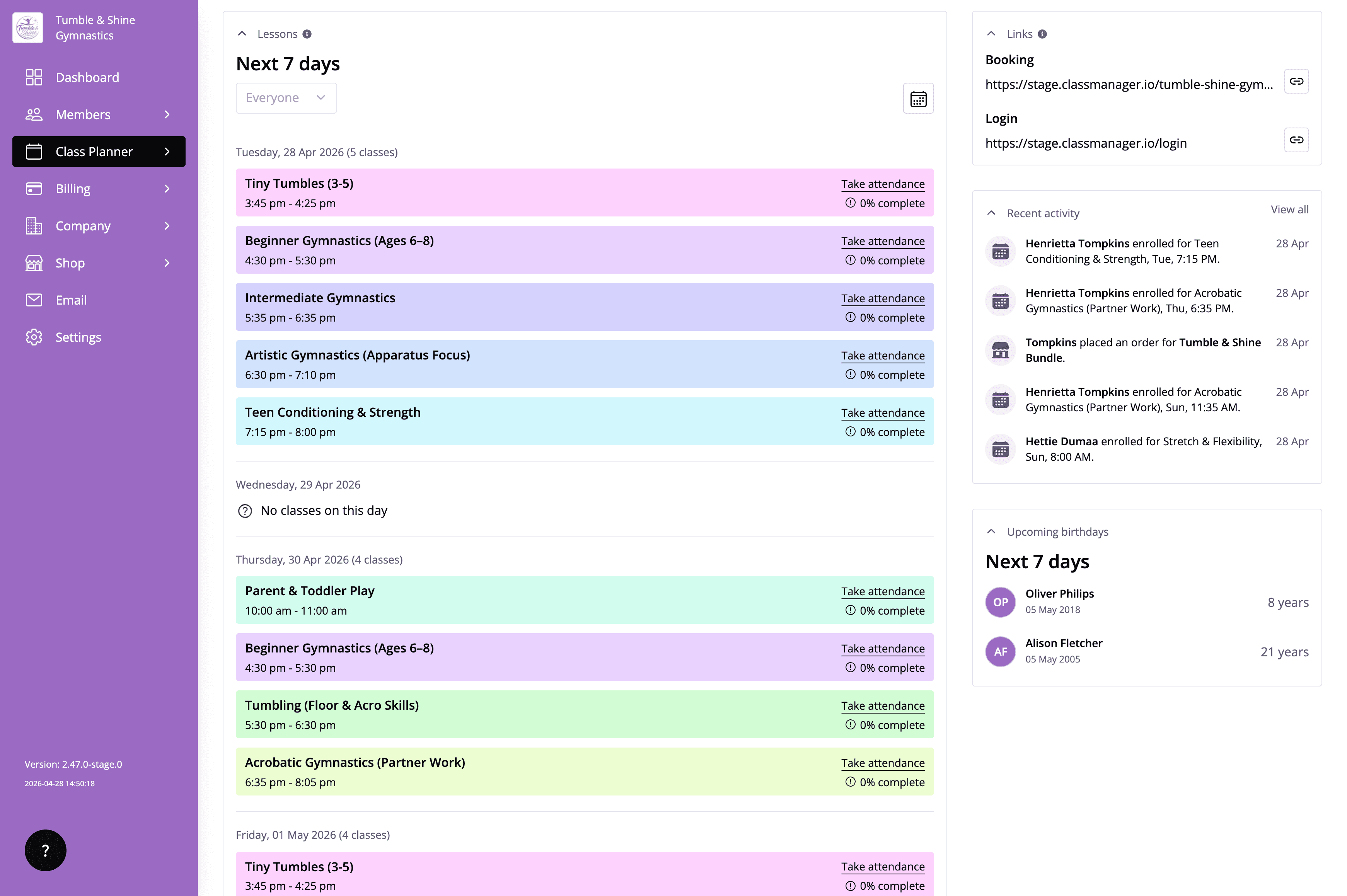
Build an operations calendar: Schedule your full year in Class Manager, 12-week terms, holiday camps, and more, with billing cycles that best suit you. The systems classes and schedules automatically to prevent overlaps and double-bookings.
Automate member onboarding: Eliminate administrative delays for new families by letting them register, sign waivers, and pay online before their first session with the easy-to-use family portal, to help manage student enrollment.
Design Scalable Class & Squad Structures
Whilst Ad-Hoc sessions may have worked when you first started, when you had to fit sessions around full-time jobs and other commitments. As you grow, ad-hoc scheduling breaks down, especially once you pass five or six sessions per week.
A clear, structured schedule that doesn't change on a whim keeps everyone aligned. Establish a clear progression framework so gymnasts can see their journey from beginner to advanced levels. Diverse programming can maximize revenue and engagement in gymnastics clubs, so don’t just offer one type of class.
Structure programs into pathways: Preschool (ages 3–5, focus on basics), recreational (5–9 and 10–13, skill-building), development squads (intermediate routines), and competitive squads (elite training with entry via skills tests).
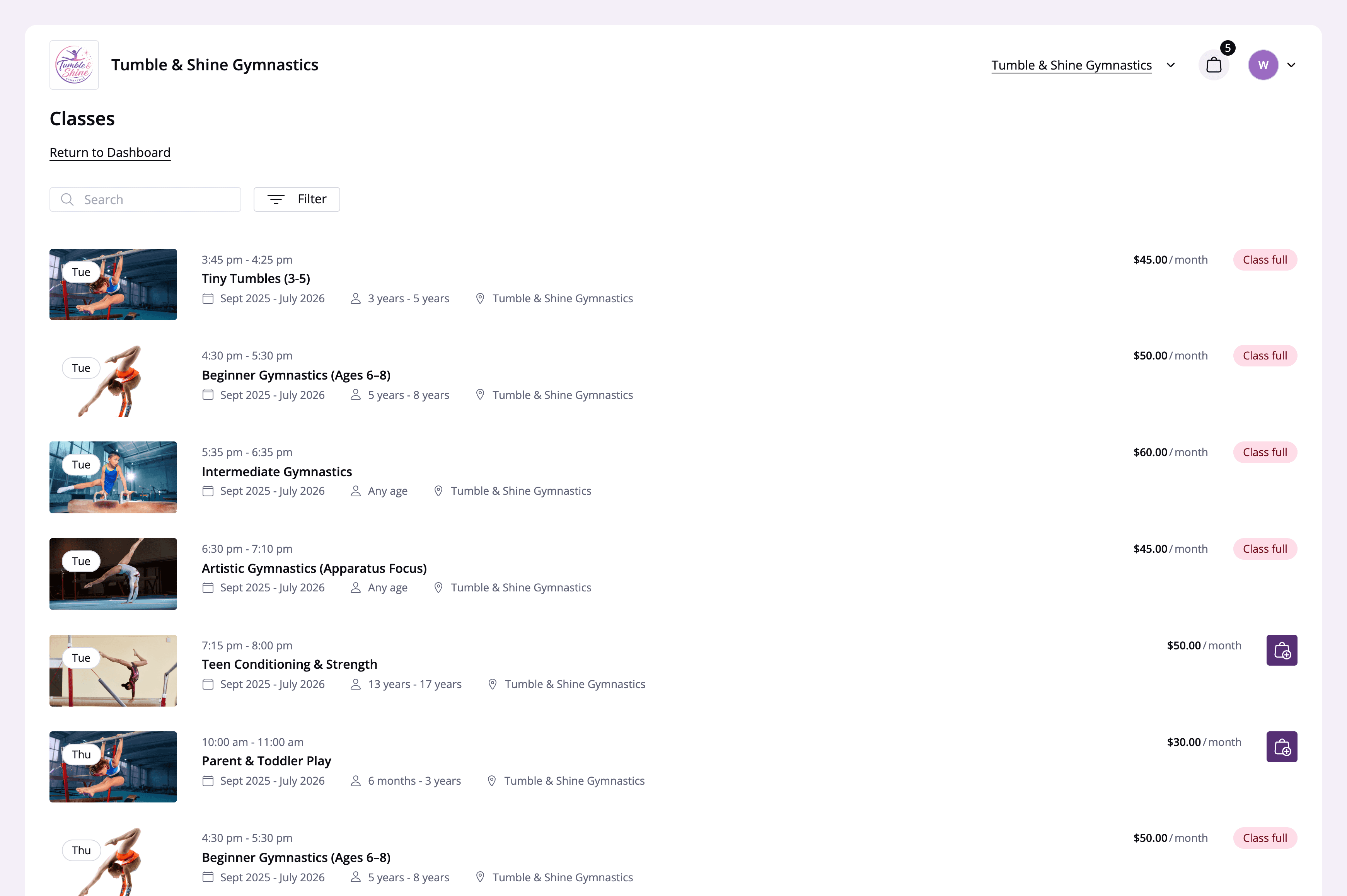
Set up programs as class types in Class Manager: Each gets its own schedule, fees (e.g., £120/term for recreational, £200 for competitive), and capacity rules. Students can join waiting lists, which can get approved, only once they've surpassed the joining requirements.
Standardize term lengths: 12-week terms with recurring weekly schedules reduce admin and make auto-billing predictable.
Track progress with data: Use Class Manager to monitor athlete attendance and skill development so coaches can make evidence-based decisions about movement between classes and squads.
Introduce off-peak sessions: Preschool, adult, or disability sessions can utilize daytime hours for better facility use and additional revenue.
Celebrate progress: Awards or showcasing achievements help keep gymnasts motivated and reinforce your progression framework.
Effective class management software allows gymnastics clubs to create multiple class types, accommodating different age ranges, skill levels, and coach assignments, all managed from one place. Find out more about the benefits of using class scheduling and registration software in our blog post.
Set Safe Capacities and Coach-to-Gymnast Ratios
Governing body guidance should drive your maximum class sizes. British Gymnastics recommends 1:8 for under-7s in apparatus work, while 1:10 is typical for older classes.
Maintaining appropriate coach-to-gymnast ratios is essential for safety in gymnastics classes, and class management software can enforce these limits automatically.
Configure capacities in Class Manager: Set maximum gymnast numbers per class based on safety standards. The system automatically prevents overbooking and generates waitlists when classes hit their limits.
Use waitlist management: Software solutions for gymnastics clubs often include features for managing waitlists, ensuring that gymnasts can be placed in classes as soon as spaces become available.
Review utilization reports: Spot under-filled or over-subscribed sessions so you can add classes or redistribute athletes appropriately.
Support safeguarding audits: Accurate digital attendance tracking and capacity logs speed up incident reviews and audit compliance, reducing review time from days to minutes. (Learn more about attendance tracking in our blog post: 'Attendance Tracking Software for Class-Based Businesses'.

Streamline Recurring Schedules, Camps, and One-Off Events
Separating term classes, holiday camps, and workshops keeps admin tidy as you scale. Think of it this way: weekly classes are your bread and butter, camps are seasonal opportunities, and workshops are targeted skill sessions. (All helping you not only generate additional revenue during the low seasons, but also helping your gymnastic studio stand out from others in your area).
Use recurring schedule tools for weekly term-time classes (e.g., Recreational Mon/Wed 4–5 pm, capacity 10). With Class Manager, it's easy to schedule classes with the copy and duplicate feature.
Create separate event setups for holiday camps (October half-term 2026, £25/day) and special workshops (bars clinic November 2026, £40/session).
Keep pricing rules consistent: Term fees vs. daily camp rates, all processed through one billing engine.
Make Parent Communication and Self-Service Effortless
Communication becomes chaotic once a club reaches 100+ families, all of whom rely on personal messaging apps and individual emails. Staff end up answering the same questions repeatedly, and important updates get lost in the noise.
Using dedicated communication tools can help streamline interactions between parents, coaches, and members, reducing information overload and improving clarity.
Centralize everything in a parent portal: An online parent portal allows parents to manage bookings, payments, and attendance, enhancing engagement and streamlining communication with gymnastics clubs.
Move key actions to self-service: New registrations, class change requests, viewing balances, downloading invoices, and signing waivers, all handled by families themselves via the easy-to-access family portal.
Effective communication tools organize messages by teams, roles, and registration status, ensuring that information is relevant and structured.
Communication tools that allow for targeted messaging can enhance engagement by enabling coaches to send updates to specific classes, groups, and individuals.
Survey members regularly: Regularly surveying members on their experiences can identify and fix pain points early to improve retention.
Updates should also be added to your website, in the venue, social groups, or other spaces, if it's an important update.
Use an Online Parent Portal & Check-In to Reduce Admin
Many gymnastics clubs utilize software that allows members to book classes directly themselves, streamlining the registration process and reducing administrative workload.
Sibling management made simple: Parents enroll multiple children, manage card details, and see class availability in real time through Class Manager’s dedicated family portal, which can be accessed on any device.
Quick check-in options: Set up a kiosk, tablet, or staff-led check-in to record arrivals automatically. Effective gymnastics club management software should automatically generate attendance registers, saving time and reducing hassle.
Reduce reception queues: Self-service cuts bottlenecks during busy after-school slots (4–6pm), especially as your club grows.
Having a parent portal can significantly reduce the administrative burden on staff by allowing parents to access information and manage their child’s participation independently.

Get Control of Money: Memberships, Fees, and Reporting
Predictable cash flow becomes essential once you take on larger rent, new equipment, or salaried coaches. Without proper systems, you could face revenue leakage from manual invoicing and late payments.
Choose your billing model: Term-based invoicing (e.g., £140 for a 12-week recreational term) or monthly memberships (£12/week). Class Manager supports both gymnastics clubs.
Structure fees clearly: Family discounts (10% for second child), squad surcharges (£50 for competitive), and optional extras like camps or leotards, all within one integrated system.
Move away from cash: Card or direct debit payments processed through Class Manager dramatically improve tracking and reconciliation compared to manual transfers (which can see 15% loss rates from errors). Or, go one step further and set up automated billing, saving you hours of time and ensuring you never miss a payday, but more on that later...
Use revenue reports by squad: See which programs are profitable—e.g., preschool at 85% margin vs. competitive at 60%—and adjust pricing or scheduling accordingly.
Automate Billing and Late-Payment Chasing
Nobody enjoys chasing late payments. Automated billing systems can significantly reduce administrative workload by managing recurring payments and tracking outstanding balances.
Set automatic invoice generation: Two weeks before each term (e.g., August 15 for September 2026), invoices go out automatically.
Configure tiered reminders: Polite, consistent late-payment emails, so you avoid uncomfortable manual follow-ups.
Switch to gymnastics club management software solutions that offer features that automatically retry failed payments, which helps ensure consistent cash flow and reduces manual chasing.
Use saved payment methods: Subscription-style billing reduces churn and missed payments as membership scales.
Save significant time: A 200-member club can save 3–5 admin hours per week with automated billing, cutting unpaid fees by 25%.
Learn more about the benefits of switching to automated billing for your club in our latest blog posts:
Switching to Auto Pay: How to Get Your Customers to Make the Change
Boost efficiency with Automated billing: Your questions answered

Keep Facilities, Equipment, and Safety Organized
Equipment layout, maintenance, and safety procedures become more complex as membership passes 120–150 gymnasts. What worked when you had three classes a week won’t scale to 15.
Create a facility plan: Which time slots use which apparatus, how many groups can safely share each area, and how class scheduling reflects this.
Keep a maintenance log: Monthly beam checks, annual pit reviews, and inspections for bars and mats, with reminders stored in your calendar.
Plan around closures: Annual floor re-spray, school hall unavailability, notify affected families via bulk messages from the platform.
Digital records matter: Attendance and incident logs support safeguarding audits and insurance claims, with processing up to 30% faster than paper records.
Plan Space Usage and Prevent Scheduling Conflicts
Map every class to a specific zone: Floor, bars, beam areas each have designated time slots to avoid double-booking.
Use a central calendar view: See all classes, camps, and events at a glance for each space in Class Manager.
Create a color-coded timetable to manage simultaneous classes across different spaces and age groups, making conflicts immediately visible.
Build in buffer time: 10-minute transitions between sessions for equipment resets, coded directly into class times.
Use Technology as the Backbone of Club Organization
Think of technology as the nervous system of a modern gymnastics club, connecting admin, coaching, parents, and finances into one coherent operation.
The temptation when growing is to piece together separate tools: spreadsheets for attendance, a payment link here, WhatsApp there. But this approach collapses, and it quickly becomes too much for one person to manage. Error rates in data entry with manual spreadsheets can lead to payments being missed, people being over- or undercharged, or students being missed off communication lists, and the admin overhead becomes unsustainable.
Class Manager is an all-in-one, cloud-based membership management software platform specifically built for dance and gymnastics clubs, replacing multiple disconnected systems with just a few clicks.
Key features that support the organisation:
Class scheduling with recurring sessions and capacity limits
Online registrations with automatically created records
Automated billing and payment tracking
Parent portal for self-service and communication tools
Attendance tracking with digital registers
Revenue and utilization reporting
Why not implement Class Manager early, so processes scale smoothly when membership doubles? The platform is free to set up with no contract, and the team can help you get everything set up.
Organize Now to Grow Confidently
The clubs that thrive aren’t just fantastic at gymnastics; they’re organized, automated, and focused on what matters most: their gymnasts, coaches, and community.
As your club grows, the cost of poor organisation shows up in staff burnout, lost revenue, and frustrated parents. Good systems unlock sustainable growth—letting you scale from 150 to 600 members without the chaos.
Ready to see how Class Manager can support your administrative structure and future expansion? Book a demo with our team, or create your free account here. You can be up and running before your next term starts, giving you back hours each week to focus on what you love: helping young people discover the life-changing benefits of gymnastics.

